Colorado’s Extended Producer Responsibility program begins to roll out in January, 2026, with an aim to give more people recycling and reduce unnecessary packaging. Here’s how it works.
It might surprise you, but Colorado has never been one of the United States’ leaders in recycling.
Colorado’s roughly 15.7% recycling and composting rate is less than half the national average.
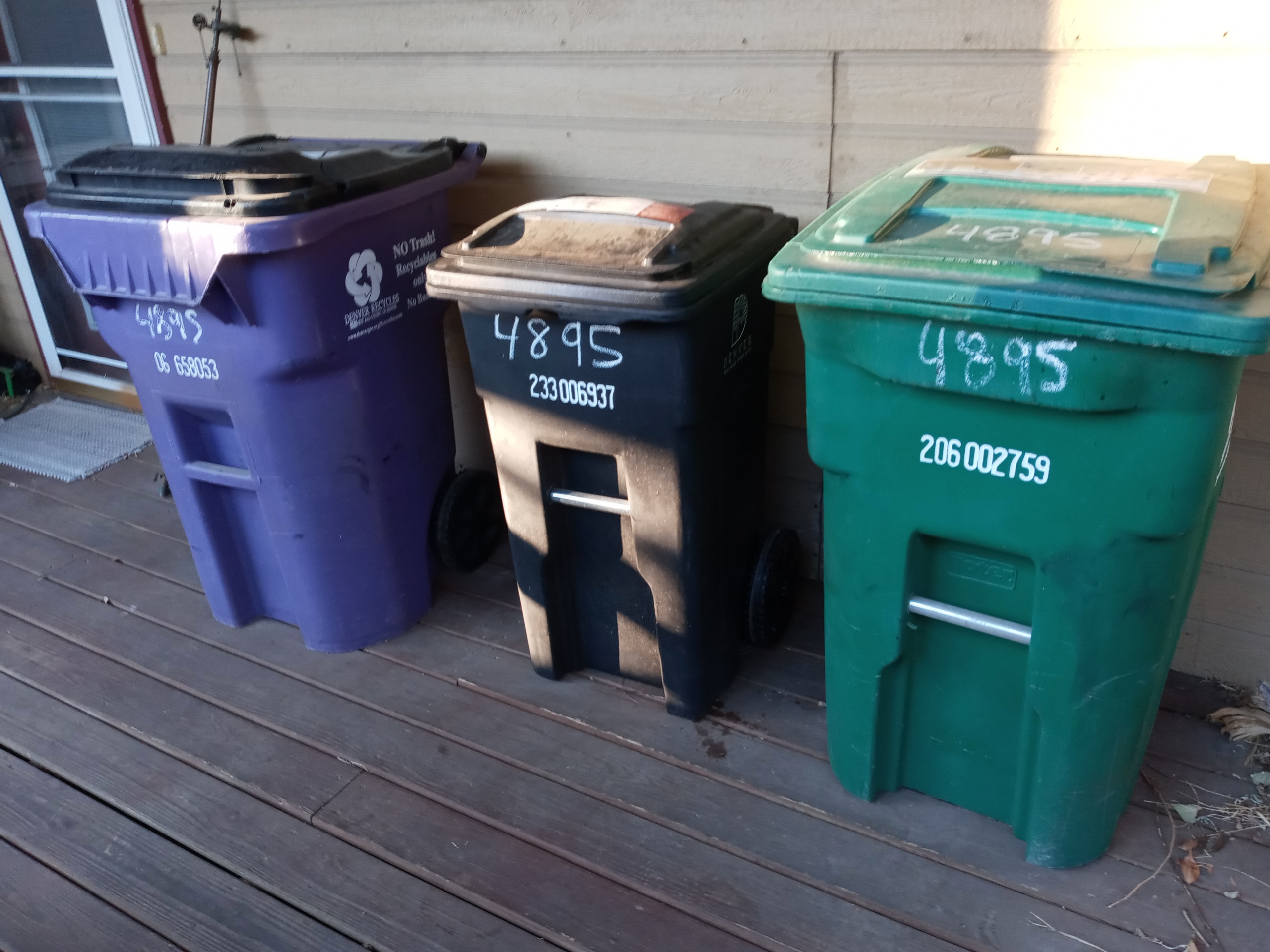
There’s a big reason for that – many Coloradans don’t have a recycling bin or a curbside compost service the same way they have a trash bin that gets picked up every week.
In fact, in our 2022 State of Recycling Report, we found that fewer than half of Colorado municipalities with a population of 10,000 or more residents automatically provided access to curbside recycling for all households.
Frankly, recycling in Colorado hasn’t been easy.
But that’s about to change.


Starting in 2026, and getting rolled out over the next five years, more and more Coloradans will get a recycling bin the same way you get a trash bin.
So, if you have a trash cart that gets collected from your curb every week, you’ll also get a recycling cart that gets picked up from your curb.
It’s estimated that the program will expand recycling to 700,000 more Colorado households. And the new program will be free of charge to the resident.
If you already pay a company to collect your recycling, that charge will be eliminated. And if you live in a city or county that already provides this level of recycling through municipal tax dollars, the city or county will get reimbursed.
It’s estimated the City and County of Denver alone could save $16.3 million dollars by 2035.
It’s all thanks to a new Extended Producer Responsibility Program that we helped advocate for in 2022 that not only expands recycling but creates a disincentive for companies to use excess or toxic packaging.
Producer Responsibility ensures producers take responsibility for all the packaging that wraps all the stuff we buy by paying a fee for every piece of packaging that they use to wrap our drinks, food and other products.
This money will be reinvested in the collection, recycling and reuse of all those cans, bottles, boxes and containers.


In 2022, the Colorado legislature passed and Governor Jared Polis signed the Producer Responsibility Program for Statewide Recycling Act, referred to as Extended Producer Responsibility (EPR).
The act required the state to set up a Producer Responsibility Organization (PRO) that will be in charge of developing and implementing a producer responsibility plan for packaging. A nonprofit called the Circular Action Alliance (CAA) was selected to be the Colorado PRO (it’s also the PRO for other states that are setting up a similar program).
Since then, a combination of state agencies, producers and an advisory board made up of recycling and waste experts has been filling in the details of the program.
Implementation will begin in January 2026.

The goal of the program is to provide recycling to 700,000 more households by 2035. That means we need to have more capacity for collection and processing, which will mean more bins, more haulers, improved facilities and the expansion of pre-existing recycling services to hard-to-reach areas.
Initial estimates are that EPR will cost about $130-$260 million dollars per year by 2030, completely covered by a fee on producers.
Extended Producer Responsibility shifts the costs of recycling off consumers, taxpayers and local governments and onto the businesses that produce the stuff we buy.
These producers will be responsible for funding the recycling system via a fee they pay based on the type and quantity of packaging they use.
For example, if you produce a tube of tooth paste, a producer that sold that toothpaste to a Coloradan would pay a small fee based on that soft, plastic tube. But, if that producer also put that tube in a cardboard box, and then wrapped that box with shrink wrap, they’d also pay a small fee for those additional layers.
It’s easy to imagine a small fee, especially if a producer uses multiple layers of packaging, to drive up the cost of the product and the price for the consumer.
The data suggests this does not happen. For example, a 2020 study conducted by RRS for Oregon’s Recycling Steering Committee, “did not find a clear correlation between product price and the presence of EPR for PPP (packaging and printed paper) policies,” when they looked at differences between items sold in Canadian provinces with and without EPR programs.
Research from the Product Stewardship Institute also suggests that consumers won’t experience a price hike due to EPR fees.
How is it possible that assessing one (or more) fees on the stuff we buy that raises hundreds of millions of dollars for big recycling programs does not drive up the price?
There are three big reasons:
Let’s take a look at each of these.
Ultimately, the goal of Colorado’s Extended Producer Responsibility system is to raise enough money to cover the cost of ensuring everyone in Colorado has the same level of access to recycling collection as their current trash service.
According to the “medium-scenario” plan, that’s going to cost producers a total of $160-$260 million per year by 2030, which includes buying more carts and recycling trucks, building more recycling facilities and employing more people in the recycling industry.
If you split the low-end ($160 million) and the high-end ($260 million), you get an estimated annual cost of $210 million. That’s a lot of money.
But we buy a staggering amount of stuff in Colorado.
Colorado’s population is roughly six million people. What if we assume that on average each person buys one can or bottle of Coke each year (Coke doesn’t publicly disclose how much they sell into our state). That’d be six million bottles, all with a small fee assessed.
$210 million divided by six million would be a fee of $35. That’s an extremely high fee.
But the consumption of Coke from bottles and cans is likely much higher than one can or bottle per person, per year.
What if the average Coloradan consumes an average of a six-pack of Coke products a year? Even that estimate seems cautious, but that would translate to 36 million Cokes a year. Divide that into $210 million and the fee is about $5.83—a smaller fee, but still high.
But wait, what about Pepsi products? And Dr. Pepper? What about beer companies and the bottles and cans they produce?
And EPR isn’t just a beverage thing. What about the bags of chips? And the bars of soap? And the containers of shampoo? And, and, and…
What if we’re dividing $210 million by a billion products? Now we’re at a fee of 21 cents. 10 billion products? The fee would be 2.1 cents. And 10 billion is probably still too cautious of an estimate.
At the end of the day, we buy so much stuff that in order to raise $210 million in Colorado, the required fee per item would be very small.
The CAA has set initial fees on the producers for 2026 as of October 2025 based on the amount and weight of the materials they use.
Even if a fee is small, if a company has to pay that multiple times because it sells a product with multiple layers of packaging, that cost will add up.
Before EPR, companies did not experience the cost that the consumers takes on for of dealing with all the packaging (much of it single-use and designed to become trash).
It was consumers that were left with the tube, box and plastic wrap from a single item we bought. It was consumers and taxpayers that had to pay for the collection and sorting of those items to get them recycled and reused, or pay for their disposal in a landfill, which includes a number of other costs like the pollution that comes from those landfills.
With EPR, companies have a price signal to reassess whether all that packaging is really needed.
Smart companies will cut out wasteful packaging, saving them money on unnecessary things like plastic shrink wrap around a box or bottle.
Less packaging means less fees and costs for everyone.
EPR fees can replace the expenses that producers accrue for materials for packaging. For example, companies can now “mine” for the materials they need from our recycling bins instead of mines in foreign countries, hard to reach areas and pristine places.
Before EPR, with a statewide recycling rate of 15%, it would be hard for any major company to trust that they could get enough aluminum or glass from Colorado’s recycling system for their products. So, it’s not a surprise they spend so much on mining, drilling and logging virgin materials.
If that rate can jump to nearly 60%, we’re suddenly giving companies a real opportunity to have a reliable supply of aluminum and glass so they can just “mine” from our recycling bins. This is especially valuable for materials like aluminum and glass that can be reused over and over again.
Ultimately, companies need to spend money on getting the materials they need for their packaging. But if the EPR fee is creating a supply stream of materials from Colorado, this fee is less and less a new expense and more an existing expense that is being shifted away from more destructive strategies of finding virgin materials to less destructive reuse and recycling systems.
A nonprofit called the Circular Action Alliance (CAA) will oversee EPR in Colorado as the Producer Responsibility Organization (PRO). The CAA is made up of representatives from different producers—like Coca Cola and Amazon—who will be responsible for identifying the costs of Colorado’s recycling expansion and the necessary fees to support that.
The CAA will also be responsible for the operation of the program and implementing any other statutory requirements.
The CAA works with the Colorado Producer Responsibility Advisory Council to create the EPR plan and implement the system and any other statutory requirements.
The council is made up of professionals representing several of Colorado’s local governments, waste facilities, nonprofits and packaging suppliers.
The Colorado Department of Health & Environment (CDPHE) will have final approval on the CAA proposals.
There’s a number of big benefits from EPR in Colorado including:
Based on an initial plan, EPR is expected to:
For many people in Colorado, you may not notice a huge difference in recycling infrastructure. That’s because some municipalities already offer recycling as part of the trash system and you already have weekly or bi-weekly recycling pickup.
If you live in a community like that, the big benefit is that it will no longer be paid for via your taxes. Producers will pick up the bill, freeing up municipal tax dollars. It’s estimated the City and County of Denver alone could save 16.3 million dollars by 2035.
You may live in an area with a municipal-run trash program but you had to find a local company, and pay a monthly fee, for recycling services. For you, that fee will go away—your recycling will be paid for by producers so you can get recycling the same way you get trash.
Finally, for the huge number of Coloradans who don’t have any curbside recycling but have curbside trash collection, you’ll start getting recycling service paid for by the producers.
In the coming months, CAA will also be unveiling a new list of recycling guidelines. Designed to be much clearer than past guidelines, this list standardizes what’s recyclable so people don’t need an advanced degree to understand what goes in a recycling bin.
No matter where you are—in the mountains, in the Denver metro area, in the Eastern Plains, etc—you’ll have the same recycling rules.
With a consistent recycling list created by the organization charged with increasing recycling, you’ll be able to have more confidence that what you put in the recycle bin actually gets recycled.
Not all materials are created equal—it’s one reason recycling is so complicated.
Glass and aluminum have a lot of value because they can be reused over and over again.
Plastics are literally a mixed bag. There are several different kinds of plastics. Some have limited reuse value, while others can’t be reused.
Some plastics contain chemicals that can be toxic. According to a 2025 study published in Nature, thousands of “chemicals of concern” have been found in plastics.
So, it’s in all our best interests to incentivize the use of materials for packaging that have a lot of value and disincentivize the stuff with limited value and/or come with higher costs when we use or dispose of them because of toxicity.
Therefore, Colorado’s EPR law encouraged the adoption of something called “eco-modulation” fees, which create incentives and disincentives for product designs based on recyclability and toxicity. Producers will pay discounted fees for recyclable, non-toxic packaging, but they will be charged an increased fee for using materials that are harder to recycle.
You can see this modeled in CAA’s 2026 Producer Dues Schedule, where highly recyclable items like glass receive a bonus that reduces its fee from 4.2 cents per pound to 4 cents per pound, while packaging like styrofoam (PS #6 – colored expanded/foamed cushioning) receives maluses that bring its fee up from 160.2 cents per pound to 172 cents per pound.
Colorado’s finalized eco-modulation plan is forthcoming.
Companies that decide to use better packaging materials will end up paying less than companies using harmful packaging materials, reducing the amount of stuff that goes to our landfills because it can’t be recycled, and the toxicity of the products we encounter every day.
Nothing we use once—just to wrap something—should go right into a landfill to create pollution. It’s a waste of resources, and we could be using those resources for better things.
Although EPR for packaging is new to Colorado, a very similar policy has been in effect since 2015 with great success. In under a decade, PaintCare, a nonprofit made up of paint manufacturers, has created a free paint recycling system for Colorado. Anyone can drop off used paint cans at PaintCare locations or receive door-to-door service for free thanks to the PaintCare fee.
EPR will apply that logic to paper and packaging, learning from PaintCare’s success. The Circular Action Alliance will play the role of PaintCare, taking on the challenge of coordinating the state’s EPR program.
Implementation begins January 1, 2026. But many of EPR’s most important benefits won’t happen overnight.
In the next five years, EPR aims to provide convenient recycling for packaging and paper products for most Colorado residents.
Here’s how EPR’s next steps will look based on CAA’s timeline:
Ultimately, by 2035, we’ll:
Former Campaign Associate, CoPIRG Foundation
Executive Director, CoPIRG Foundation
Danny has been the director of CoPIRG for over fifteen years. Danny co-authored a groundbreaking report on the state’s transit, walking and biking needs and is a co-author of the annual “State of Recycling” report. He's helped pass bills to ensure Coloradans have the Right to Repair, funding for Colorado's Bustang program and bans on PFAs chemicals in dozens of household products. He also helped write a 2016 Denver initiative to create a public matching campaign finance program and led the early effort to eliminate predatory payday loans in Colorado. Danny serves on the Colorado Department of Transportation’s (CDOT) Efficiency and Accountability Committee, and CDOT’s Transit and Rail Advisory Committee. Danny lobbies federal, state and local elected officials on transportation electrification, expanding transit options, zero waste, consumer protection and public health issues. He appears frequently in local media outlets and is active in a number of coalitions. He resides in Denver with his family, where he enjoys biking and skiing, the neighborhood food scene and raising chickens.