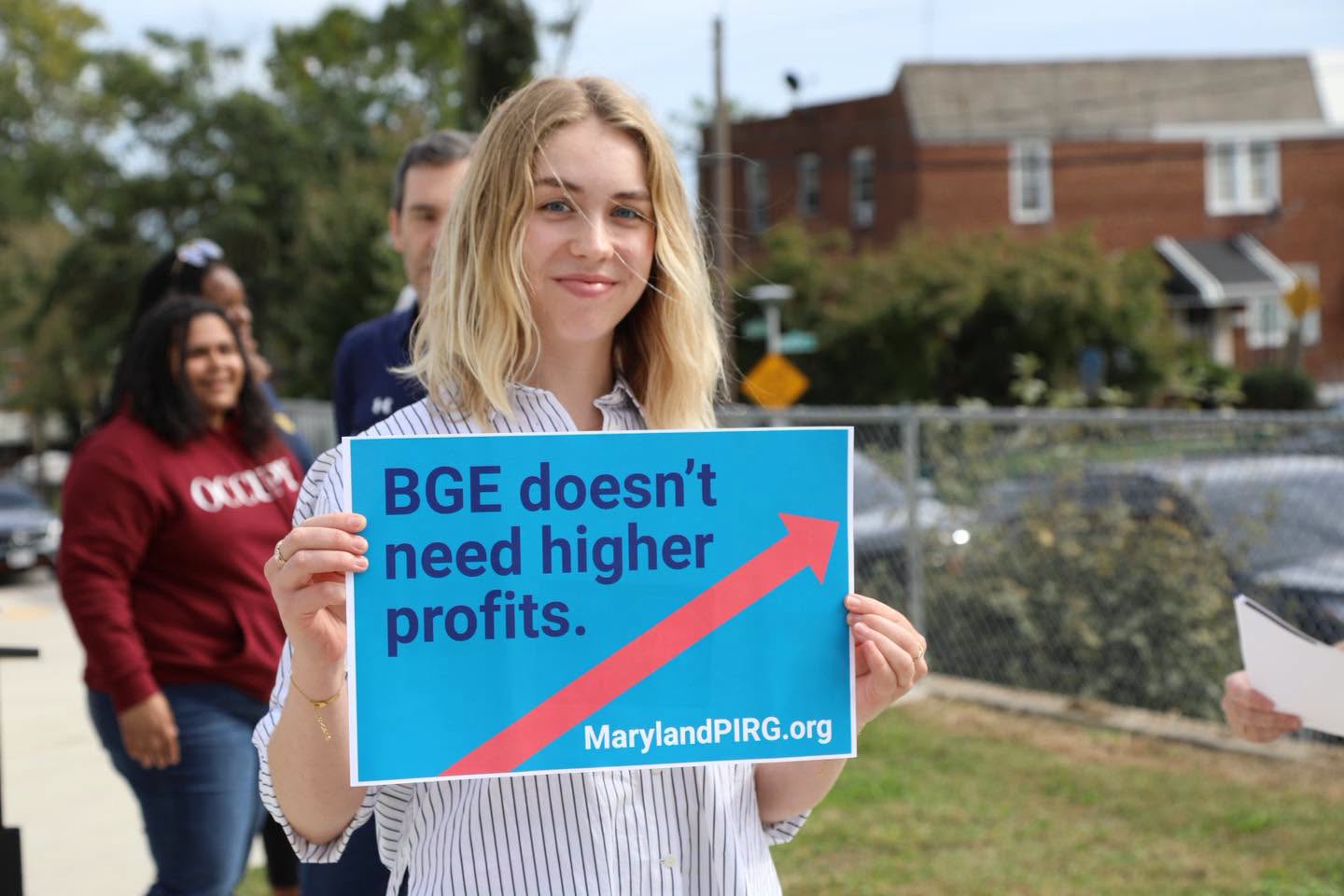
Summer bills continue to rise as BGE seeks to increase its delivery rates, again.
Updated

BGE gas and electric delivery rates have increased far faster than inflation. BGE gas delivery rates have tripled since 2010 and gas customers now pay $2 for delivery for every $1 they pay for the gas itself. Electric delivery rates have doubled since 2010.

The more BGE spends, the larger its opportunity to profit. When it builds new pipes or wires, it earns profits on the expense, similar to a mortgage or high interest credit card. This creates a powerful incentive for wasteful spending.
BGE profits have nearly quardrupled from $147 million in 2010 to $578 million in 2025.

BGE has spent $1.4 billion on “Operation Pipeline,” its gas pipeline replacement program. If BGE completes its proposed $4 billion in gas pipeline spending it could cost customers $19.5 billion to pay back, largely due to BGE profits.

Maryland PIRG’s report Fast-Tracked and Flawed found that BGE is not adequately prioritizing safety in Operation Pipeline, and that the program may actually be slowing the work to repair or replace the most at-risk pipes.
Multi-year rate plans (MRPs) allow utilities to ask for rate increases in advance of spending instead of making them defend any extra spending, increasing their financial incentive to spend wastefully.This method of “forecasting” spending increases shifts financial risk from shareholders to ratepayers. Rate increases under MRPs have been at least 40% higher than rate increases in Maryland from 2006-2020. In 2026 the state legislature put a 1 year moratorium on new forecasted rates and multiyear rate plans in Maryland.
We need our utility regulators and legislators to hold BGE accountable to stop wasteful spending that is driving up our bills.
In 2025 the legislature passed important legislation to ensure gas pipeline spending prioritizes safety and to stop wasteful spending by gas and electric utilities using MRPs, but we’ll need to push hard to ensure utility regulators follow through.
Office of the People’s Counsel: Why is my BGE bill so high?
The Insiders Guide for Applying to Home Energy Assistance
Energy Efficiency: How to access your utility’s EmPOWER program
BGE electric supply rates went up by roughly 25% last September.
Electric supply rates have spiked dramatically this year across all 13 PJM states including Maryland due to PJM mismanagement.

Compared to other grid managers, PJM has one of the longest timelines in the country for connecting new clean energy projects.
Maryland lawmakers passed legislation in 2025 to speed up deployment of energy storage, one of the fastest and most cost effective ways to bring new energy online.
PJM’s decision not to count energy produced by two active power plants in their supply pool caused as much as 65% of BGE bill increases we saw in 2025. After pushback from consumer advocates, PJM changed that policy for 2026, but we’re stuck paying an estimated $5 billion based on that anti-consumer policy choice.
The same energy companies who play a powerful role in the decision making at PJM are seeing significant financial gains because of the auction results.
Utility companies are also seeing windfall profits due to PJM mismanagement. BGE was granted a no-bid contract to build a new transmission line without a competitive process and without considering cost effective alternatives to transmission. BGE’s projected costs have already doubled from $800 million to $1.5 billion.

PJM has enough electricity to meet demand for the nearterm. But PJM is projecting a massive increase in demand due to data centers.
It’s unclear if and how much this increase will actually come. But Maryland electric customers are already seeing higher rates because PJM is making residential households and small businesses bear the costs for new generation and transmission instead of the large users.

Using the time-tested tools of investigative research, media exposés, grassroots organizing, advocacy and litigation, Maryland PIRG Foundation, a project of U.S. PIRG Education Fund, a 501(c)(3) organization, stands up to powerful interests and delivers concrete results. But we need your support to keep our work going strong.
As threats to the public interest grow, our work becomes more important every day. Every contribution powers our research, fuels our advocacy, and sustains our future.
Senior Advisor, Maryland PIRG Foundation
Emily provides campaign strategy, communications and policy guidance for Maryland PIRG's program and organizational development. She also leads Maryland PIRG's energy and utility work to ensure Marylanders have access to clean, affordable and efficient energy. Since joining Maryland PIRG in 2013, she has led and worked in coalitions to strengthen democracy in Maryland, improve public health, reduce exposure to toxic chemicals, and improve access to clean, affordable and efficient energy. She has authored or co-authored reports on money in politics, PFAS and energy efficiency. Prior to her work in Maryland, Emily spent eight years working with the Student PIRGs. Emily lives in Baltimore with her husband and kids, where she enjoys coaching her daughter's soccer team, working in the garden and cooking.