

New restrictions affect only toys, not water beads for decorative or plant hydration purposes

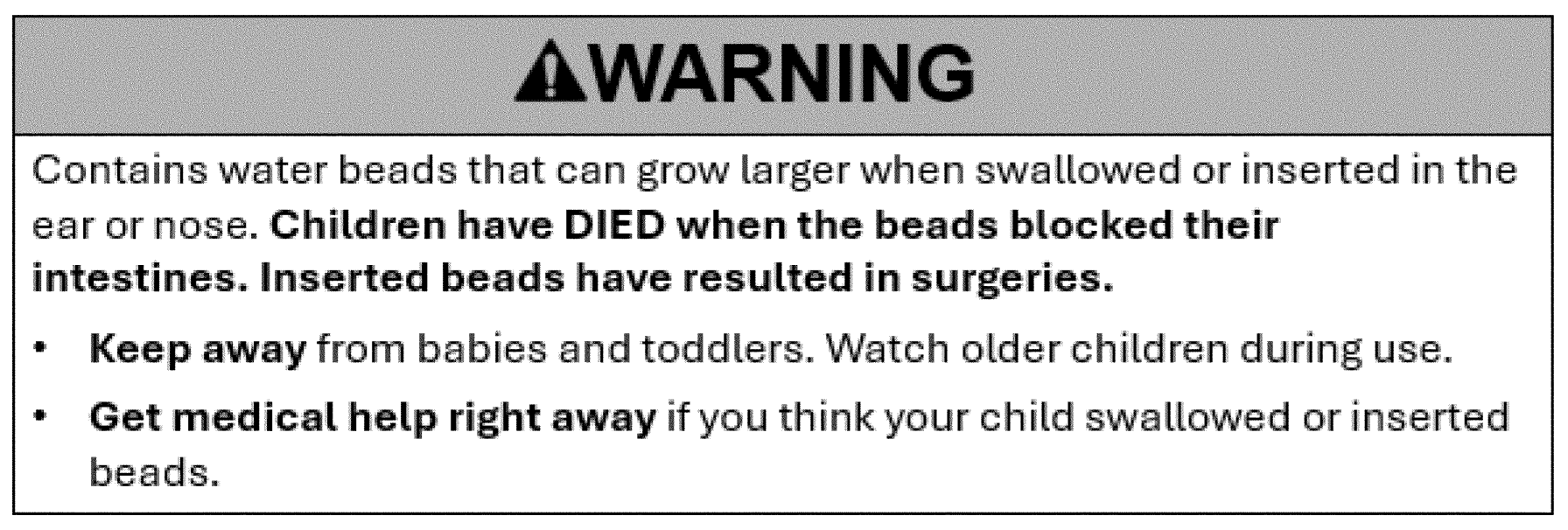
It’s been at least 15 years since safety regulators knew that water beads could be dangerous for children. Finally, as of today, the most dangerous types of water beads can no longer be sold as toys in the United States.
The problems with toy water beads:
The new rules that take effect today:
Water beads work like this: They come in packages of hundreds or thousands. You can put several or perhaps dozens in a bucket or large container and add water. Within hours or a day or two, depending on the brand, you have a bunch of rubbery, squishy balls that can be fun to play with. Companies have often marketed water beads as sensory toys for people on the autism spectrum.
More than 12,000 people – most of them children – were treated in hospital emergency rooms from 2017 through 2023 for injuries, illnesses or incidents involving water beads, according to the Consumer Product Safety Commission (CPSC).
One of those children was Kipley Haugen, a 10-month-old from Texas who, unbeknownst to her parents, ingested water beads belonging to her older sister in 2017. After unexplained illness and emergency surgery weeks later to remove pieces of water beads, Ashley Haugen and her husband thought Kipley was on the mend. But Kipley was later diagnosed with toxic brain encephalopathy caused by acrylamide poisoning. Many water beads contain acrylamide, according to the CPSC, although the toxin and carcinogen is often not disclosed on packaging.
Ashley Haugen became a massive force on a mission to do something about the water beads that forever changed their lives. She reached out to any and every news outlet and consumer advocate she could find, and was so relentless that she became known as “that water bead lady.” She later founded a non-profit by that name and has worked to educate families and lobby regulators and lawmakers to do something about water beads.
The new rules have been “a long time coming,” Haugen told U.S. PIRG Education Fund.
“Water beads have sent hundreds of children to the hospital with catastrophic, preventable injuries,” she said. “Today, this rule, together with the historic policy choice by retailers such as Amazon, Walmart and others to stop selling water beads as toys, marks a turning point and reflects a level of care and leadership that will help protect children for years to come.
“I’m proud to have played a part in helping bring this over the finish line,” Haugen said, “and I’m deeply grateful to every family who shared their story, every volunteer, every partnering organization, every CPSC staffer, and all of the CPSC commissioners who helped make this moment possible.”
For us at PIRG, we’ve often wondered this: When someone came up with the idea of water beads, what in the heck were they thinking? Did they say, “Let’s make a toy that looks like candy, but if someone eats it, it could literally kill them.” Water beads as toys seemed like a disaster waiting to happen from day one.

Photo by Courtesy of CPSC | Public Domain
Water beads are known by different names, including orbs, gel beads, super-absorbent polymer balls and jelly balls. One of the first products recalled – if not the first – was in 2012. A company called Dunecraft recalled about 95,000 Water Balz toys because “when the marble-sized toy is ingested, it expands inside the body and causes a blockage in the small intestine,” the announcement said, “resulting in severe discomfort, vomiting, dehydration and could be life threatening. The toys do not show up on an x-ray and require surgery to be removed from the body.” The toys would expand from marble-sized to racquetball-sized, which is about 2-1/4 inches.
The recall followed a report to the company about an 8-month-old girl from Texas who ingested a Water Balz in August 2011 and required surgery to remove the toy to resolve an intestinal obstruction.

Photo by Courtesy of CPSC | Public Domain
The dangers of water beads became more widely known in 2023 following the July 2023 death of Esther Bethard, a 10-month-old girl in Wisconsin. That tragedy led to a huge recall in September 2023 of about 52,000 activity sets by Buffalo Games, sold exclusively at Target. Esther died after ingesting multiple water beads, which later expanded in her body. Buffalo Games was also notified that Kennedy Mitchell, a 9-month-old girl in Maine, was seriously injured in November 2022 after swallowing some of her older sister’s water beads, and they caused an intestinal obstruction. Surgery was required to remove them. She was hospitalized for weeks.

Photo by Courtesy of CPSC | Public Domain
In December 2023, after a campaign led by Consumer Reports, major retailers such as Amazon, Target and Walmart said they would stop selling water beads marketed as toys. But water beads have still been available on many, many e-commerce sites.
In March 2024, the CPSC issued urgent product safety warnings for two other water beads products after the companies wouldn’t cooperate with a recall. They were Tulado and Jangostor. Besides the dangers of expansion in a child’s body, both products contained acrylamide in violation of the Federal Hazardous Substances Act, the CPSC said. Ingestion of these products led to surgery for one child involving a Tulado water bead and two children involving Jangostor water beads. Both products were sold through Amazon.
While we applaud the new rule, we don’t believe it goes far enough. Lawmakers introduced two bills into Congress back in late 2023 and early 2024, the Ban Water Beads Act and the bipartisan Esther’s Law, named after the Wisconsin baby who died. Both bills stalled in committees.
Overall, laws passed by Congress are stronger than rules approved by a regulator. And the new rules don’t go far enough because they allow some water beads to be marketed as toys, which is confusing messaging. Both bills would prohibit water beads marketed for children for any purpose: for play, education, sensory stimulation or crafts.
In addition, the rules allow water beads that would be prohibited as toys — because they expand to dangerous sizes — to be sold for decorative or plant hydration purposes in the same bright, candy-like colors that have posed a problem.
The other unfortunate reality: The new rule can’t address the water beads already in homes and daycares. All that regulators and consumer advocates can do is warn families and others who may have water beads purchased previously that can expand to dangerous sizes.
Our advice: Water beads intended for any purpose should not be in any homes, daycares or other buildings where children or pets could ever be.
Consumer Watchdog Director, U.S. PIRG Education Fund
Teresa directs the Consumer Watchdog office, which looks out for consumers’ health, safety and financial security. Previously, she worked as a journalist covering consumer issues and personal finance for two decades for Ohio’s largest daily newspaper. She received dozens of state and national journalism awards, including Best Columnist in Ohio, a National Headliner Award for coverage of the 2008-09 financial crisis, and a journalism public service award for exposing improper billing practices by Verizon that affected 15 million customers nationwide. Teresa and her husband live in Greater Cleveland and have two sons. She enjoys biking, house projects and music, and serves on her church missions team and stewardship board.


